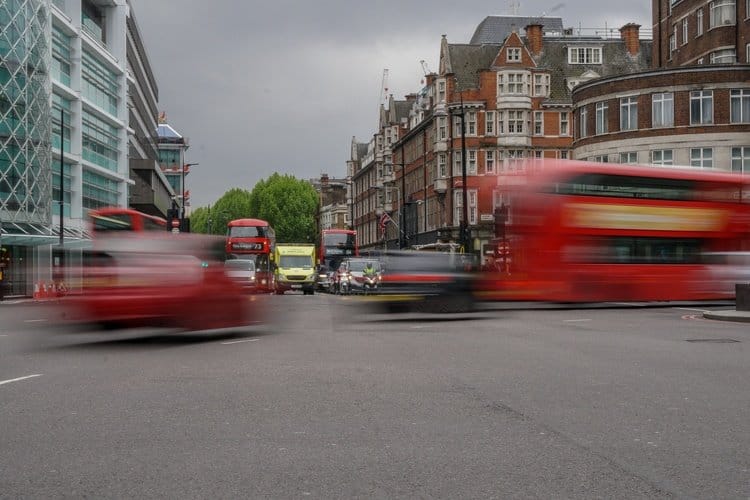
There was a moment in the long, strange summer of 2020 when it looked like Covid might change London.At the time, it felt like the pandemic would transform many things, including the way the city functioned.The streets of the capital, long devoted to dangerous metal canisters of fumes, felt alive and human again.Major boulevards were closed to private traffic, and new low-traffic neighborhoods and bike lanes sprung up.After the reopening of the world, bars and restaurants in Soho began to pop up on the semi-pedestrianized streets.Then London became congested with traffic and cars, a congestion charge was imposed.
London – the most congested city in Europe despite the city vignette
But that, like so many of the changes wrought by the pandemic, turned out to be a mirage.Westminster Borough Council lifted traffic restrictions in Soho, while Kensington and Chelsea broke ground on a brand new cycle lane.Meanwhile, low-traffic neighborhoods have brought the English closer to civil war than Brexit.After all, the car remained king.
Twenty-two years after the introduction of the city vignette, London is somehow the most congested city in Europe.Drivers in the capital spent an average of 101 hours in 2024 in congestion, compared with 97 hours in Paris and 81 hours in Dublin.No other city in the UK comes close: the second most congested is Bristol, whose roads kept drivers stationary for just 65 hours.
How the pandemic changed the streets of London – and why did the effect disappear?
The situation in the capital has worsened, with average hours of traffic in London increasing from 99 the previous year and 97 the year before.In Manchester, congestion worsened even faster, with a 13% increase in delays.Inrix, the transport analytics company behind this new study, has estimated that the losses to London's economy are around £3.85 billion, which equates to £942 for each of the city's 4 million drivers.
The biggest question raised here is: who the hell chooses to drive in London, the city with the best public transport system in Britain?Of course, some of those using the capital's streets will be traders, delivery drivers, people with mobility difficulties or others whose journeys are unavoidable.The numbers will also be boosted by Inrix's broad definition of 'London': a 7km stretch of the M25 is listed among the capital's most congested roads.However, this is hardly enough to explain why the worst traffic in Europe should be located in a city with one of the most extensive public transport systems in the world.
What needs to be done to clear the roads?
One frequently touted solution, both in London and elsewhere, is simply to build more roads.Some, such as the Silvertown Tunnel, which is to relieve the Blackwall Tunnel, have already been given the go-ahead to build.Others, such as the dreaded 1960s plans for an eight-lane motorway through Brixton and Islington, have thankfully fallen through.As mayor, Boris Johnson proposed his own version of the project, with the idea that the roads would be built underground.This never happened because high costs and technical impossibility stopped most of his grandiose ideas.

Such schemes are unlikely to solve the problems, thanks to the well-documented phenomenon of 'stimulated demand': when journeys that would previously have seemed unnecessary become possible, people tend to take them and new roads quickly fill up with cars.This explains every picture you've ever seen of seven-lane highways in Los Angeles completely jammed with cars.If you build roads, they will come.
City vs. cars: why the battle for London's streets is onso difficult?
The beauty of boosted demand, however, is that it works the other way around: if you make driving more difficult, people will find less aggravating, less toxic alternatives.This, along with simply making neighborhoods nicer and healthier, was one of the goals of low-traffic neighborhoods.Other European cities have found their own ways to reduce the space allocated to cars: introducing "road diets", reducing the number and width of lanes;turning riverside highways into parks in Paris;introducing 'superblocks', essentially giant ones, close to Barcelona's low-traffic city-wide neighbourhoods.
There are other ways to make driving less attractive.Athens and Delhi have experimented with rules limiting the days cars can access the roads by license plate.The range of Central London city vignettes may be expanded or their price may be increased.By the end of 2023, according to London Centric, transport authorities in London are considering even more extreme measures: Project „Gladys' would introduce a Singapore-style scheme that charges drivers per mile. Such a scheme would increase costs for those who have to drive, yes - but they would also be competing for space with fewer other vehicles when they do.
The politics of public discontent: the real obstacle to change
The real barrier to such schemes is the public.The Mayor of London, Sadiq Khan, canceled Project Gladys for fear of being accused of waging a war on motorists.
London is no exception in this regard.In Manchester, a similar vignette was decisively rejected in a referendum in 2008, and weaker measures were dropped.This week, New York City became the first American city to have a vignette covering the lower half of Manhattan.A resident of the wealthy Upper East Side is furious that he will pay a fee to visit his children.They live only eighteen blocks away.
There will always be voices against driving restrictions.In London, people don't want their own cars restricted, only other people's.We can blame the politicians for the traffic jams.But at some point we have to admit that we are the problem.
See more information about vignettes here!
Source: The Guardian